
Territory War
Your chat, fighting over a board
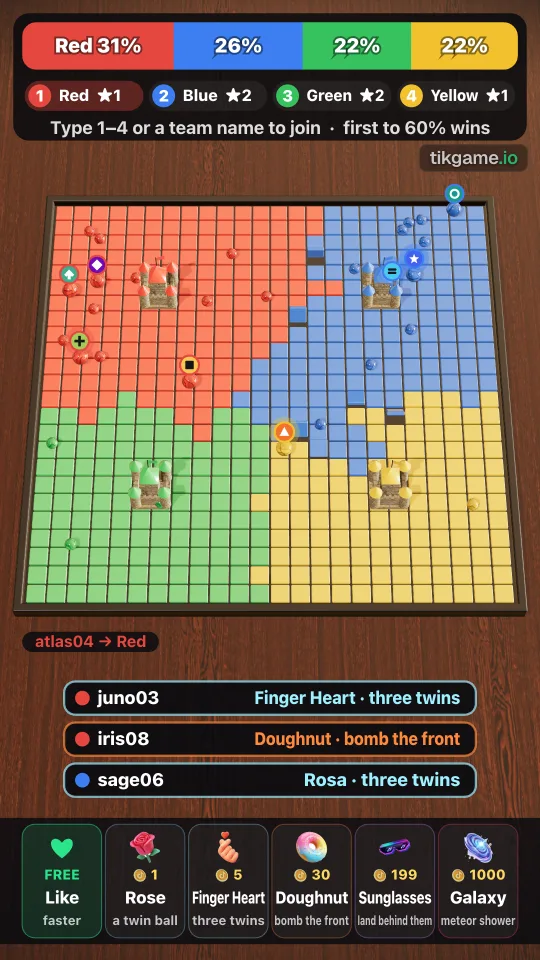
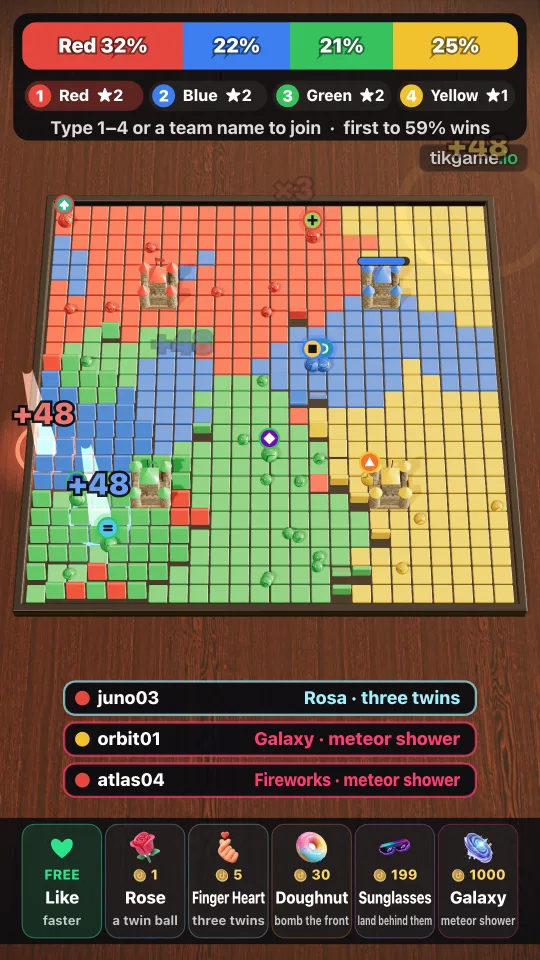
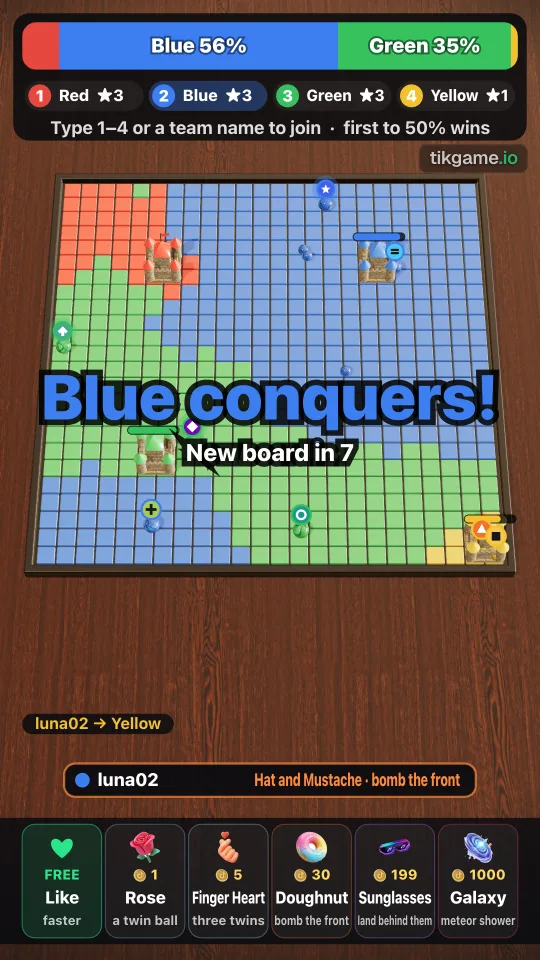
Your chat splits into teams and fights over a table of tiles. Every viewer is a glass marble with their own face over it, rolling through their team's colour and turning over every enemy tile it hits. A like makes it roll faster; a gift drops more marbles, a bomb or a meteor shower onto the board. The first team to hold the line takes the board, and a fresh one is laid out, for as long as you are live.
- 2–6
- teams, named by you
- 150
- marbles at once
- 5
- gift rungs
- 3D
- glazed tiles and glass marbles
How it plays
Pick a side by typing it
Type a team's number or its name and you are on it. Or just tap: your first like puts you on a side and you stay there. Changing sides is allowed once every two minutes.
A like is speed
Every like is distance your marble rolls, so tapping harder makes it roll faster. Each enemy tile it bumps into turns over into your colour, and nothing you send is thrown away. With nobody tapping it only crawls, and after 20 seconds it falls asleep where it stands, greyed out, until your next like wakes it.
Every team has a keep
Enemy marbles chip at it. When it falls, the attackers take the ground around it, and the keep is rebuilt deeper inside its own land — so a team pushed back has somewhere to hold.
The line comes down, so every board ends
The first team to hold the line wins the board, and you set where the line starts. It comes down slowly as the board goes on, so a stalemate always ends. Then a fresh board is laid out, the wins are counted in stars, and nobody is knocked out or reset.
A gift lands on the board
Twin marbles that roll on their own, a bomb on the front line, a landing deep behind the enemy, or a meteor shower that hits five times. A gift sent while a win is being shown is held for the next board, not burned.
A table, not a diagram
Glazed tiles that flip over, glass marbles that really roll, stone keeps with roofs in each team's colour, all lit by a real room. A PC with no 3D graphics gets the same game drawn flat.
What a gift buys
The same ladder the server charges for. A gift that cannot climb a rung still buys something.
- freeComment
Type a team's number or name to join it
- freeLike
Join a side, and your marble rolls faster
- 1–4 🪙Rose
A twin marble that rolls for your team on its own
- 5–29 🪙Finger Heart
A swarm — three twin marbles at once
- 30–198 🪙Doughnut
A bomb on the front line, turning a patch of enemy ground
- 199–999 🪙Sunglasses
A landing deep behind the biggest enemy's lines
- 1,000+ 🪙Galaxy
A meteor shower — five landings, one after another
What it looks like on stream
Real captures from real rounds, not mockups.
Same link, other game
Switching game is a setting, not a new setup. Your viewers do nothing differently.
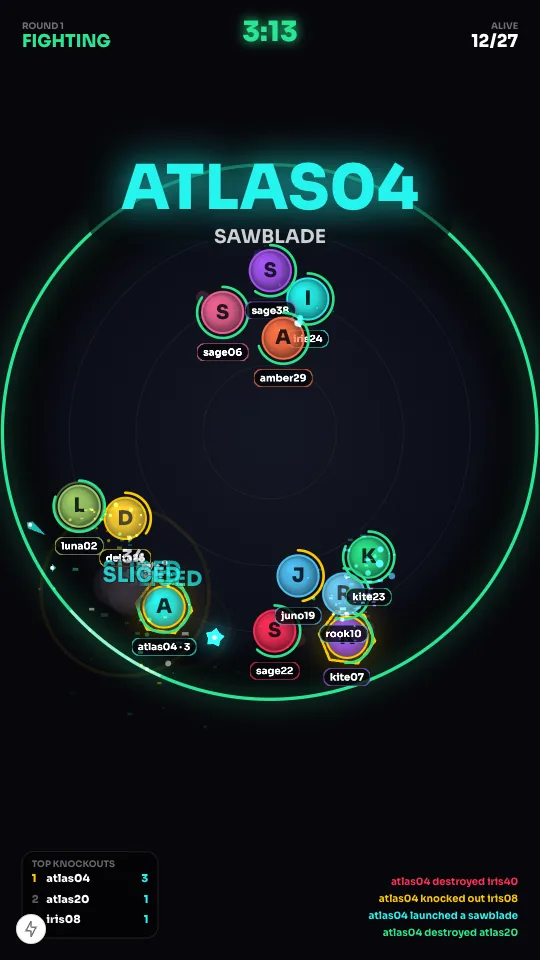
Anyone who chats, likes or gifts drops into the ring as a fighter with their own name above them. Bodies collide with real momentum, bullets are the only way out, and the most knockouts takes the round.
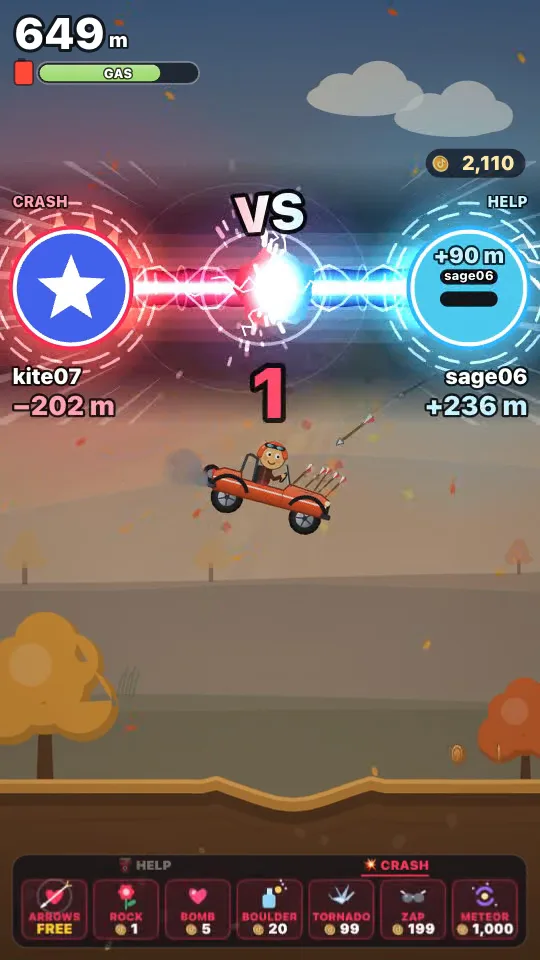
Every other game here is played by your viewers while you watch. In this one you are the driver: you steer an open-top off-road jeep down an endless, hilly road from your phone or your computer, and your room fights over how far you get. Every like is an arrow that knocks you back, and gifts throw you back harder — a bomb, a tornado, a Galaxy's meteor — while your fans carry you on with nitro, a tailwind, a rescue helicopter and a whale's wave. When big gifts from both sides land at once, their senders face off in a beam duel, and the winner takes the jeep. The score is how far you got.
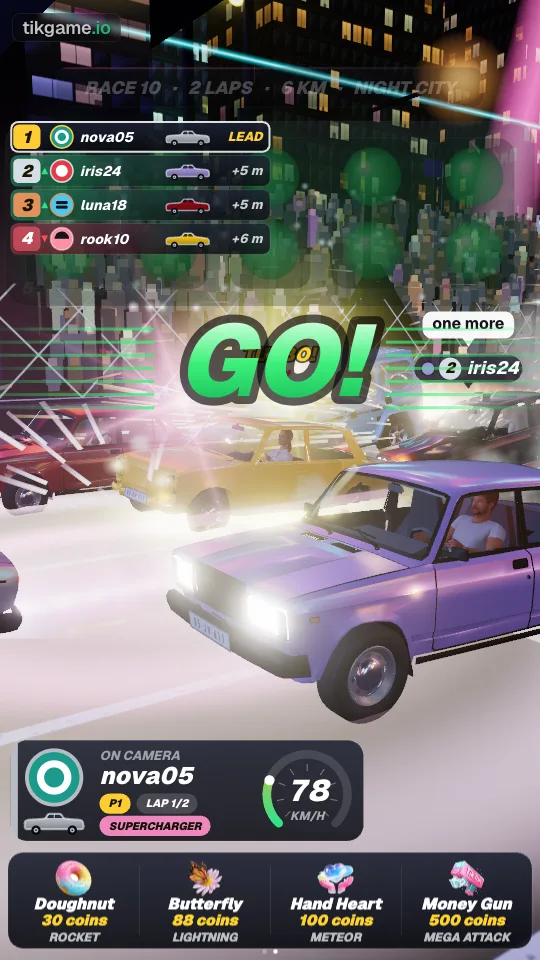
Everyone who walks into your LIVE, comments, likes, follows or sends a gift gets a car with their name over it and their own number plate, and races everybody else lap after lap through a neon night city, a port at sunset and a Soviet district: over bridges and under them, through tunnels, mud and water, and off jumps into the air. Likes are gas, every gift is nitro on the sender's own car, and from 20 coins it also puts the sender in one of the expensive cars and throws a fire bomb, a rocket or a lightning storm at the cars ahead, while a broadcast camera shows who threw what at whom. The grid, five red lights, a podium — then the next race in the next world.
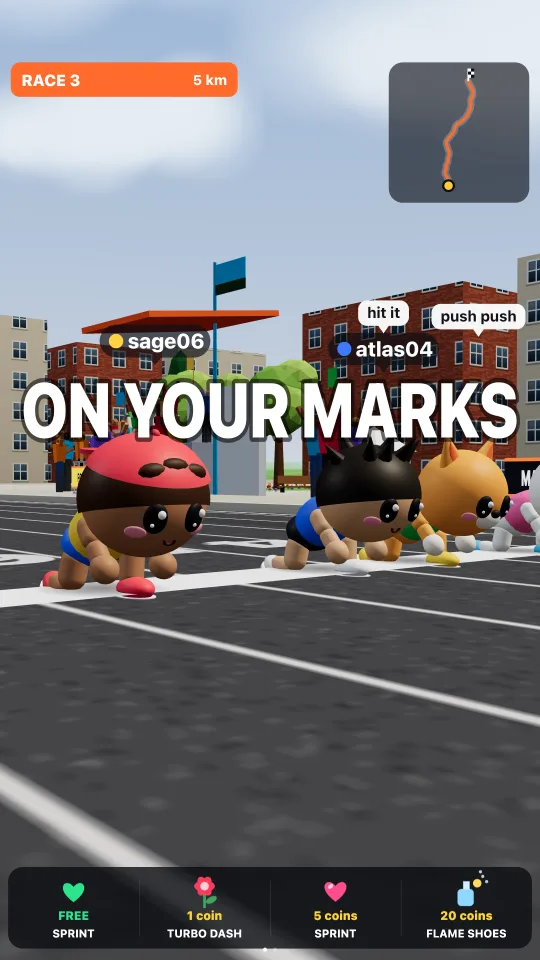
Everyone who walks into your LIVE, comments, likes, follows or sends a gift becomes a runner — one of 36 cute characters, with their name over it — racing everybody else for minutes down kilometres of winding road through town, forest, mountains and desert. Likes are speed, every gift is a burst of speed on the sender's own runner, and from 20 coins it also throws a fireball, a rocket or a lightning storm at the runners ahead, while a broadcast camera follows the leader, the pack and every blow. On your marks, set, the gun, a podium — then the next race on a new course.
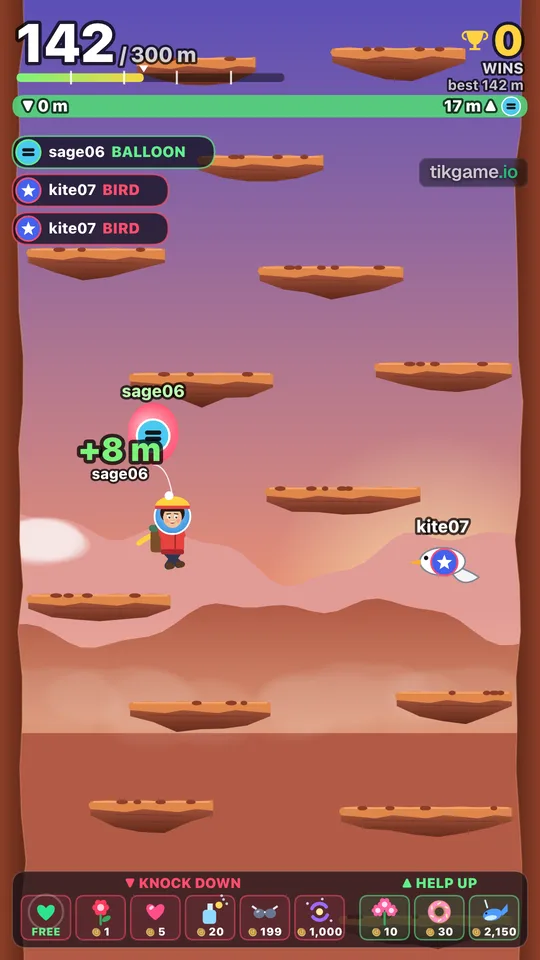
Every other game here is played by your viewers while you watch. In this one you are the player: you run and jump your way up a mountain, from your phone or your computer, and everything your room sends is aimed at you. Likes blow wind across the cliff, a Rose sends a bird with the sender's face on it, a Galaxy brings a meteor down — and your fans fight back with balloons, shields, heart wings, a rescue helicopter and a rocket. Reach the flag and it counts as a win.
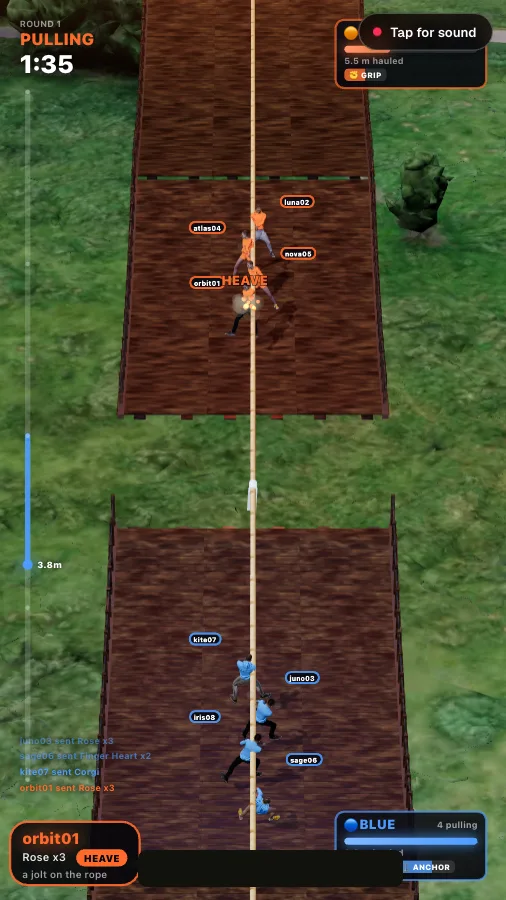
Comment or like and you're pulling — for whichever side is behind, so the two teams stay even without anyone picking one. A hundred people tapping is what actually moves the knot, not one person mashing harder. Six gift rungs buy six different kinds of leverage, from a grip that hauls on its own to a titan worth a dozen pairs of hands. Lose the pull and your side is walked backward off the edge of the boards.
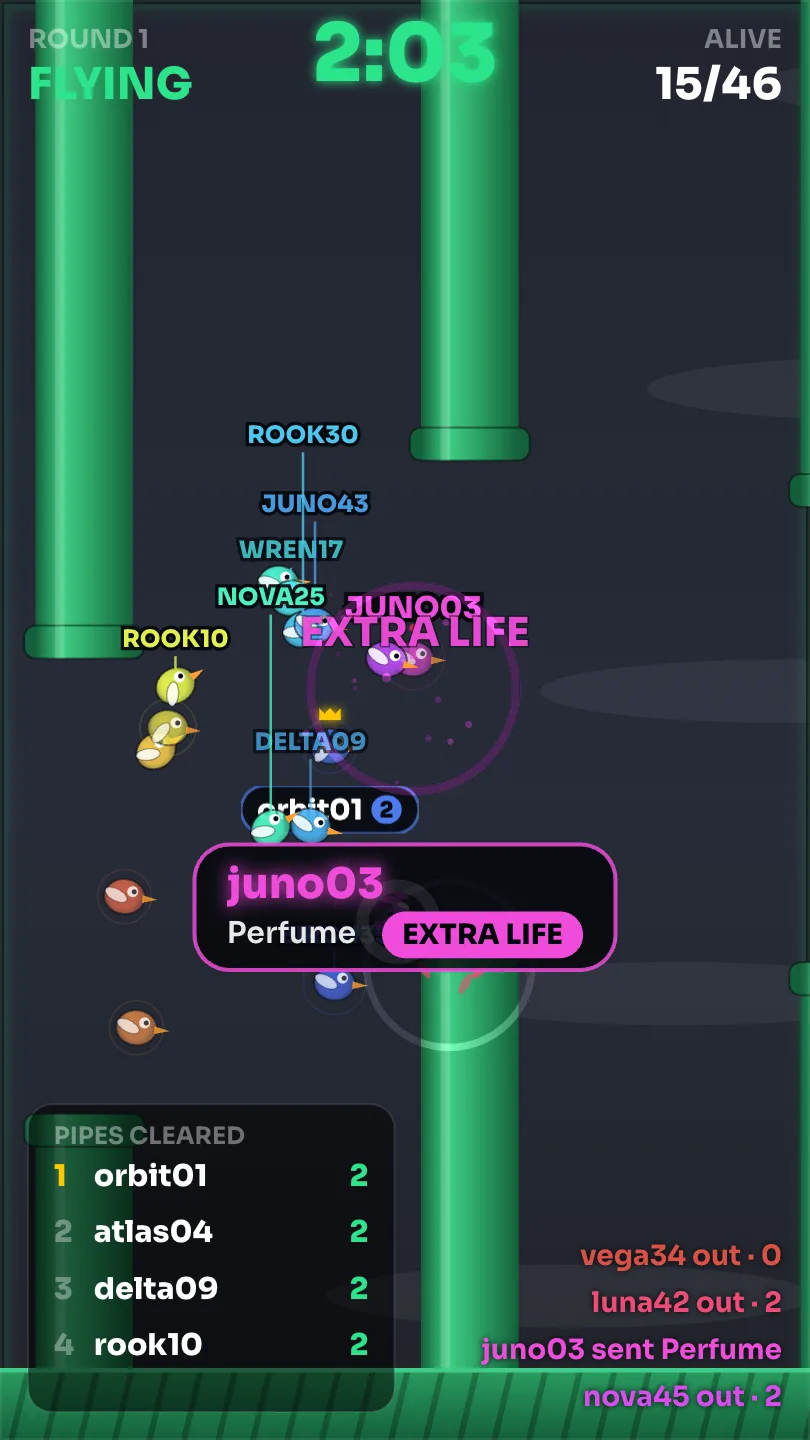
Everyone watching gets a bird, and a like is the only input the game needs — the cheapest thing TikTok can send is the only thing it asks for. The bird flies itself and nothing can hit it; what a viewer owns is the fuel, and the tank empties every second whether they tap or not. Run dry and the bird drops out of the sky and sits on the ground until the next like lifts it — nobody is ever knocked out. Birds tire, too: the longer one stays up the heavier it gets, so even somebody tapping without pause comes down eventually and takes off again rested. There are no rounds: the flight runs as long as the stream does, and the board counts how much of it each person kept their bird in the air.
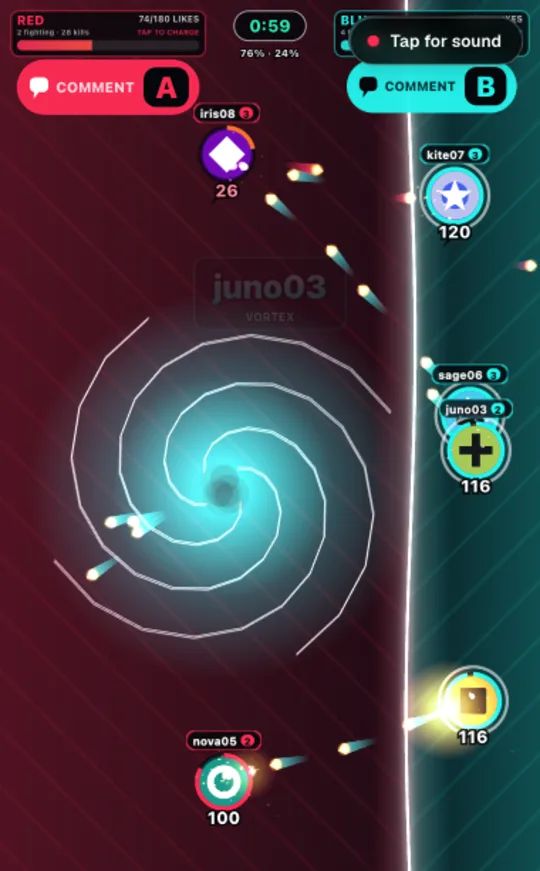
Type a side's name in chat and your fighter spawns there and walks to the seam to fight whoever's opposite. Likes charge your team's shared nuke and fire your own fighter's next shot; a hundred and fifty of them and the whole team drops one on enemy territory. Gifts buy five ranged attacks, from a bullet spray up to a nuke that shoves the border itself. Whichever side is stronger at the seam pushes it back, so the score is ground you can see, not a number nobody reads.
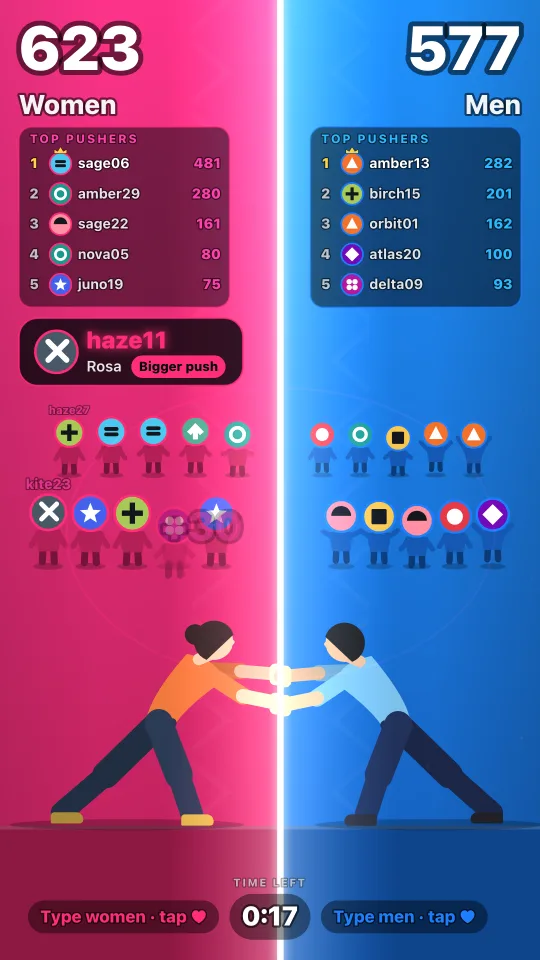
One word in chat puts a viewer on a side and their own face in its crowd, and from then on every like they send pushes the line between the two — heard from their side of the room and seen rising off their face. Each side ranks its own pushers, the whistle names each side's MVP, and three minutes decides it, unless one side is pushed clean off the screen first.
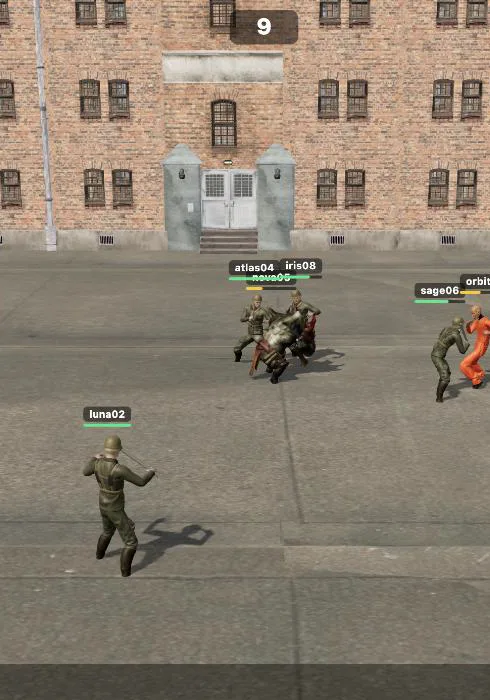
A like costs nothing and puts you in the pit as a bare convict; a gift climbs you up a seven-rung ladder priced off the gift's own coins, so a rung really is as much stronger as it is dearer — from bare fists to a club, a bow, a rifle, and a knight in full plate at the top. Two of the seven shoot instead of swinging, and closing the distance on them is how the fighters below them answer back. Likes bank punches rather than throwing them on the spot — a swing is an animation with a real wind-up, so a like adds to what the next blow carries, and it lands on the frame the fist or the arrow actually arrives. Nobody stands still waiting to be tapped for: fighters close, circle, give ground and trade on their own. There are no rounds — the yard opens with the stream and never closes. Going down costs you the costume, not your evening: three seconds later your next like puts you back in as a convict, or a gift brings you back at once and re-arms you on the way.
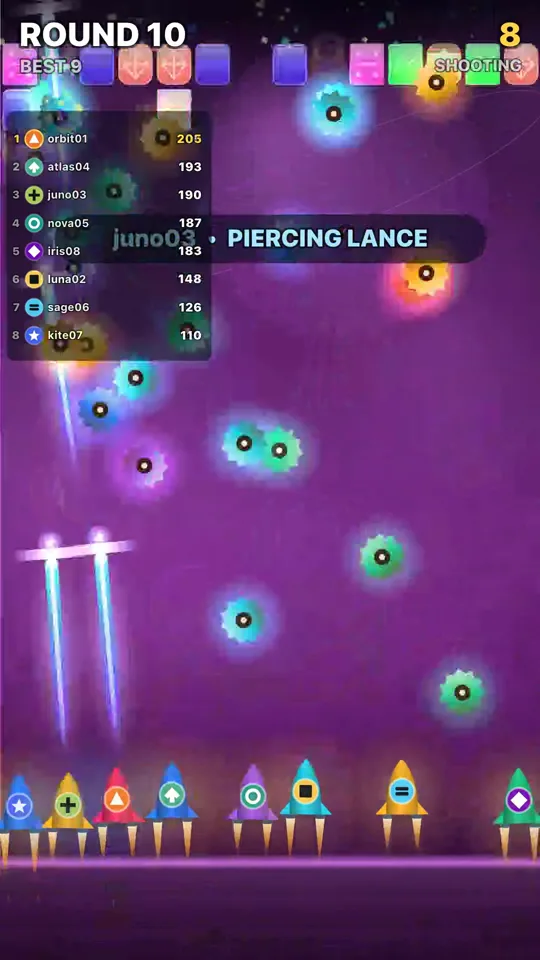
No sides and no duel: everybody who likes gets a rocket on the deck and the room shoots the same wall together. It comes down a row at a time and a round is only over when the last block of it is gone, so the finish line is real — and the next round's blocks are tougher, in new colours, against a new sky. Likes are the ammunition and they are paced rather than dumped, so a viewer tapping without pause fires without pause. Gifts buy ten seconds of being a different gun, and each rung answers a different problem the wall is giving you — never just a bigger number.
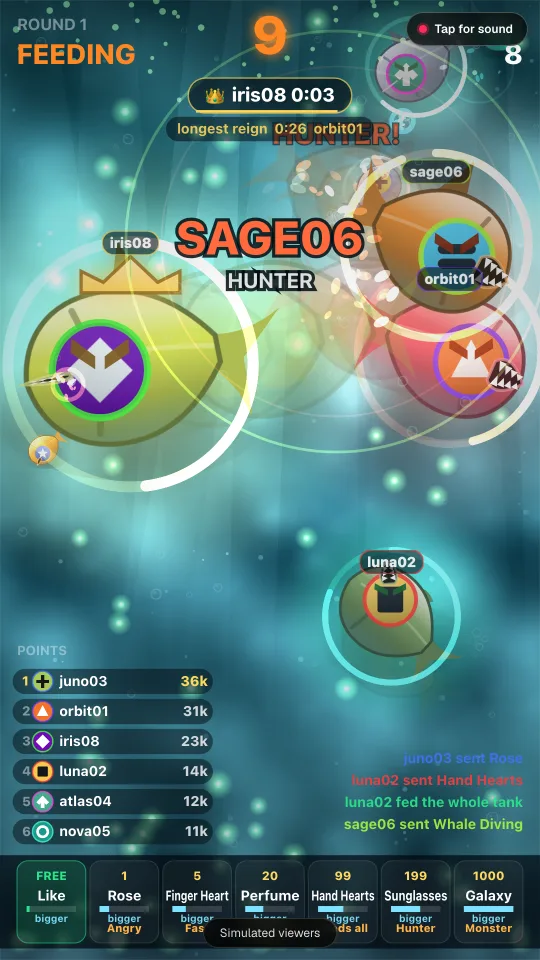
Everyone who plays gets a fish carrying their own profile picture. A like feeds it and it shrinks every second whether you tap or not, so the tank is a live readout of who is still playing. A gift does something else entirely: it enrages your fish. It goes red, outswims everything calm in the water, stops being afraid of anything and tears lumps out of whatever it catches. Bitten down to nothing, a fish is swallowed and comes straight back as a minnow — nobody is ever out.
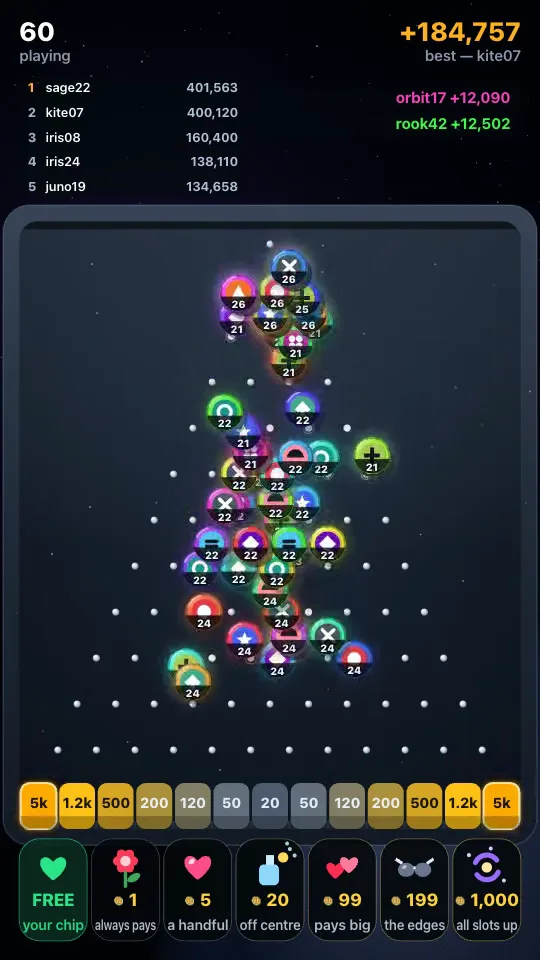
A like drops a chip with your face on it, and it falls twelve rows of pegs to whichever bucket it bounces into. The middle is where a chip most wants to land and it pays 20; the two outside buckets pay 5,000 and almost nothing gets there. Tapping harder does not send more chips — it sends heavier ones, and the number on a chip's face is what your tapping is worth when it lands. A gift does the one thing effort cannot: it decides which part of the board your chips are allowed to fall into.
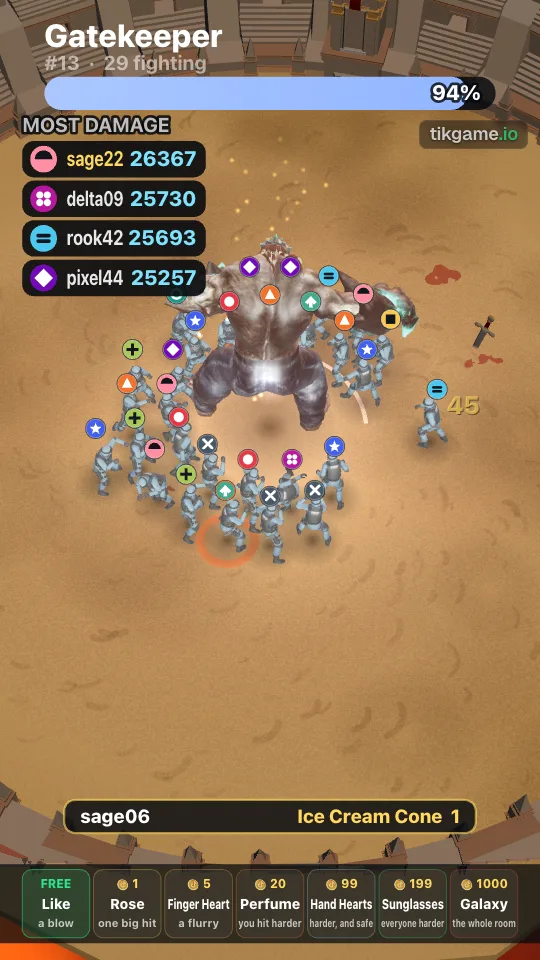
Every other game here splits your chat. This one puts all of it on the same side. Everyone who taps is in the ring — no seats, no waiting — a like throws a blow, and one shared health bar says how it is going, the same picture at eight viewers and at six hundred. The boss sweeps the ring and kills whoever it hits; tap again and you are back in. Put it down and a bigger one walks in, for as long as you are live.
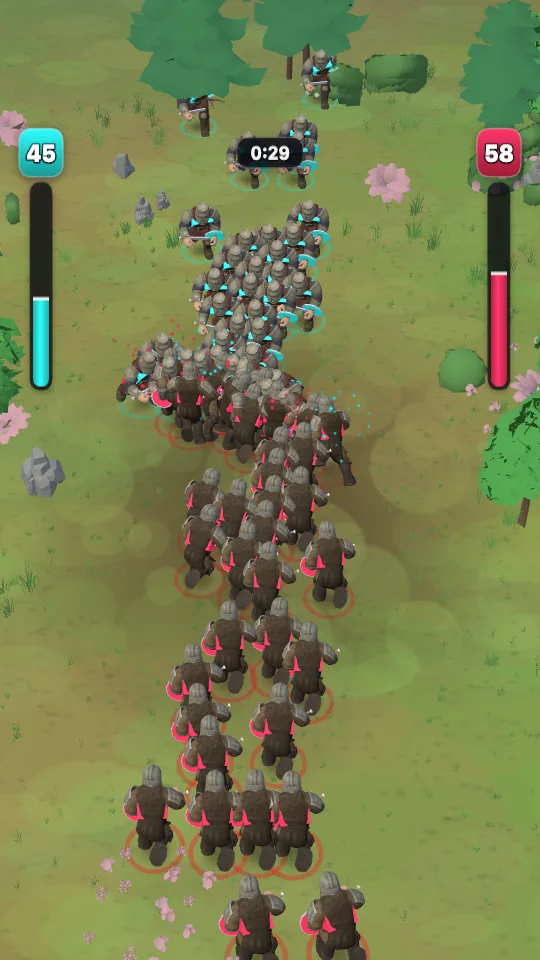
A hundred soldiers, fifty a side. Like and yours runs onto the field with a sword; keep tapping and it swings four times harder than one nobody is playing. A gift arms it instead: an archer, a wizard, and a king at the top, and anything too small to climb a rung sends your soldier into a rage instead. Knocked down, it is back in seconds on the same side with everything it earned. Most kills takes the field, and the three who did the most are named on it. Switch one setting and the room picks its own sides by typing a word — two named armies, and no even-ing up.